
Man’s Best Friend. A Politician’s Best Image?
From the White House to your mailbox, dogs have become familiar faces in American politics. But what exactly are they communicating?
There’s something almost irresistible about a photograph of a politician with a dog.
A Labrador resting beside the president. A Cocker Spaniel beloved by a candidate’s daughters. A family portrait featuring three dogs, arriving in the mailbox just weeks before an election.
We recognize these images immediately. They feel familiar, personal, and reassuring. But have you ever wondered why dogs appear so frequently in political life?
And more importantly, what are we supposed to see when they do?
The Dog That Made Political History
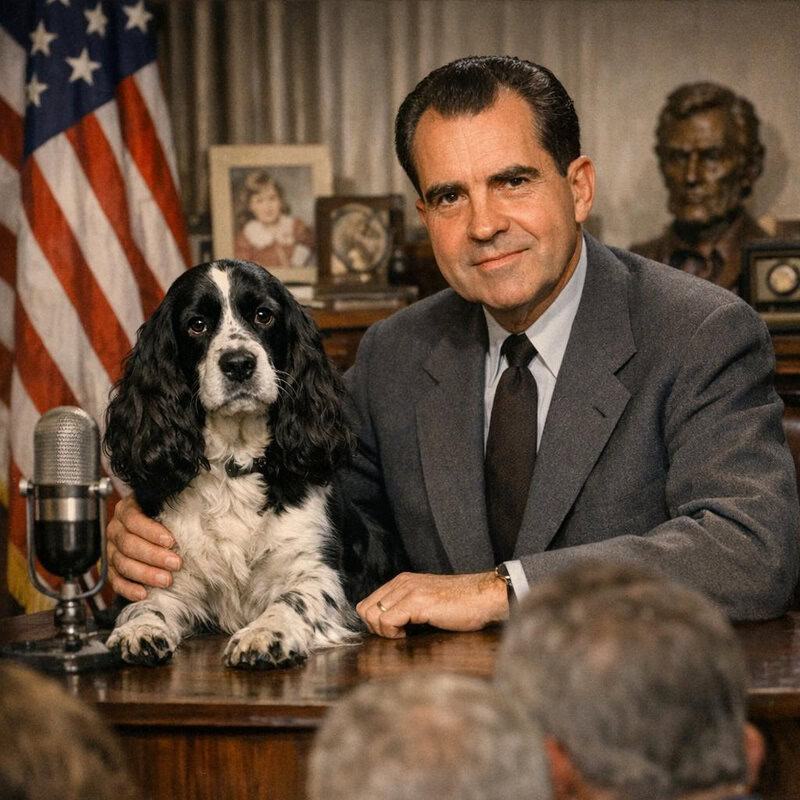
In 1952, Richard Nixon faced questions about a fund established by his political supporters. With his place on the Republican presidential ticket in jeopardy, he delivered a televised speech defending his finances.
Then he introduced America to Checkers.
The Cocker Spaniel had been given to his daughters, and Nixon declared that his family intended to keep him regardless of the controversy.
The speech became so closely associated with the dog that history remembers it as the Checkers speech.
Checkers was a real family pet. But he also became part of one of the most memorable moments in American political communication.
More Than a Cute Photograph
Researchers have studied whether dogs influence how people respond to politicians.
One study examining politicians’ social media posts found that including dogs increased feelings of personal connection, favorable reactions to the posts, and reported intentions to vote for the politicians.
Another study of the 2008 presidential election suggested that Barack Obama’s lack of a dog may have affected his appeal among dog owners. That interpretation was subsequently challenged by other researchers.
The science is more complicated than simply saying dogs win votes.
Still, it raises a fascinating question: When we see someone with an animal we love, do we begin to feel that we know something about the person?
What Are We Really Seeing?
Recently, a Fresno City Council campaign postcard arrived featuring a candidate, his children, and three dogs.
It was a familiar political image: family, companionship, and an appealing glimpse of life outside public office.
But the photograph prompted another question.
Can a dog be a genuinely loved family member and, at the same time, part of a carefully constructed political image?
Of course. Those possibilities aren’t mutually exclusive.
The more interesting question may be what we, the viewers, bring to the photograph, and what we’re invited to believe.
This week on Beyond the Leash, we’re exploring the remarkable history of dogs in American politics, the psychology behind political imagery, and why the family dog can mean so much more than meets the eye.
